


Natural Hair Colour for Grey Hair




Natural Hair Colour for Grey Hair: How to Choose, Apply & Maintain It
Decision Point 1: Is Natural Hair Colour Actually Right for Your... Read More
Natural Hair Colour for Grey Hair: How to Choose, Apply & Maintain It
Decision Point 1: Is Natural Hair Colour Actually Right for Your Grey?
Before shade charts and application guides, the most important question is whether natural hair colour for grey hair is the right category for your specific situation.
Natural hair colour for grey hair is the right choice if:
You are covering grey fully or partially and want to maintain grey coverage indefinitely without cumulative chemical damage. Natural colour can be applied every four weeks without structural harm to the hair, which makes it ideal for the long-term, regular maintenance that grey coverage requires.
You have experienced scalp sensitivity, burning, itching, or allergic reactions with conventional dye. The absence of PPD (paraphenylenediamine) and ammonia in natural hair colour eliminates the two primary chemical allergens in conventional dye.
You have an existing scalp condition (psoriasis, seborrheic dermatitis, contact dermatitis) that is worsened by high-pH alkaline hair colour chemistry.
You are concerned about the cumulative health impact of repeated PPD and ammonia exposure through the scalp, which is one of the body's most permeable surfaces.
Your hair is already weakened, whether from previous chemical colour, heat damage, or hair fall, and you want colour that strengthens rather than further compromises the shaft.
Natural hair colour for grey hair may require additional consideration if:
You want to achieve a shade lighter than your current hair colour. Natural colour deposits but does not remove existing pigment. If you want to go lighter than your base, a lightening process is needed first.
You have very resistant grey with extremely tight, low-porosity cuticle structure. This is addressable with extended processing time and heat, but requires more attention to technique.
You are used to a 35-40 minute conventional dye process. Natural colour for grey hair requires 35 minutes plus a heat step for complete coverage. If time is a significant constraint, this is worth factoring in.
Decision Point 2: Understanding Why Grey Hair Behaves Differently
Grey hair is structurally different from pigmented hair in ways that directly affect how natural colour behaves on it. Understanding these differences explains why specific application techniques are needed.
Melanin absence: Grey hair has no melanin in the cortex. This means there is no competing pigment, and the deposited colour is the only pigment present. The result tends to be vivid and clean, without the underlying warm or cool tones of natural pigment influencing the outcome.
Cuticle structure: Many people find their grey hair has a tighter, more compact cuticle than their previously pigmented hair had. This tighter structure reduces porosity, making the hair more resistant to colour penetration. This is why grey hair is called "resistant grey" and why it needs longer processing time than pigmented hair.
Reduced sebum: Scalp sebum production decreases with age. Sebum partially conditions the hair shaft and softens the cuticle naturally. In its absence, the cuticle may be harder to penetrate with colour pigments.
Texture change: Many people find their grey hair grows in with a coarser, wiry texture. This is related to changes in the hair follicle's shape as it ages, which alters the cross-sectional profile of the hair shaft and changes how it feels and behaves.
These characteristics explain why standard natural colour application instructions (mix, apply, wait 30 minutes) often produce incomplete grey coverage, and why a grey-specific application protocol produces complete, even results.
Decision Point 3: Choosing the Right Shade for Your Grey
Shade selection for natural hair colour on grey is the decision that most affects satisfaction with the result. Several factors are relevant.
Proportion of grey: If you have 30% grey, the same shade will produce a different overall result than if you have 90% grey. The grey portions absorb botanical pigment most fully and match the shade chart most closely. The pigmented portions absorb the colour on top of their natural melanin, producing a blend. A higher grey percentage means the shade chart prediction is more accurate.
Your skin tone: Indian skin tones generally fall into warm (yellow, olive), cool (pink, blue-red), and neutral categories. As a general guide:
Warm undertones: dark brown, medium brown, burgundy. The warm botanical pigments complement and deepen existing warm undertones.
Cool undertones: natural black, neutral brown. Cool-toned shades complement without clashing.
Neutral undertones: the full range works well. Neutral skin tones have the most flexibility in shade choice.
The result you want:
To be as close to your pre-grey colour as possible: match your memory of your original hair colour to the shade chart as accurately as you can.
For a colour that blends grey naturally without full coverage: choose a shade one or two levels lighter than your target. The grey portions will show a lighter version of the shade, creating a natural blend rather than full uniformity.
For maximum impact and full grey elimination: choose natural black or dark brown, which provide the most visible contrast and the most complete coverage on resistant grey.
The specific shades in a complete natural hair colour for grey hair range:
Natural Black: cool, deep, shiny. Covers grey completely. Works on all skin tones and base colours. The most predictable result on resistant grey.
Dark Brown: rich chocolate with warm undertones. Multidimensional in natural light. The most popular shade for women who want visible colour without maximum contrast.
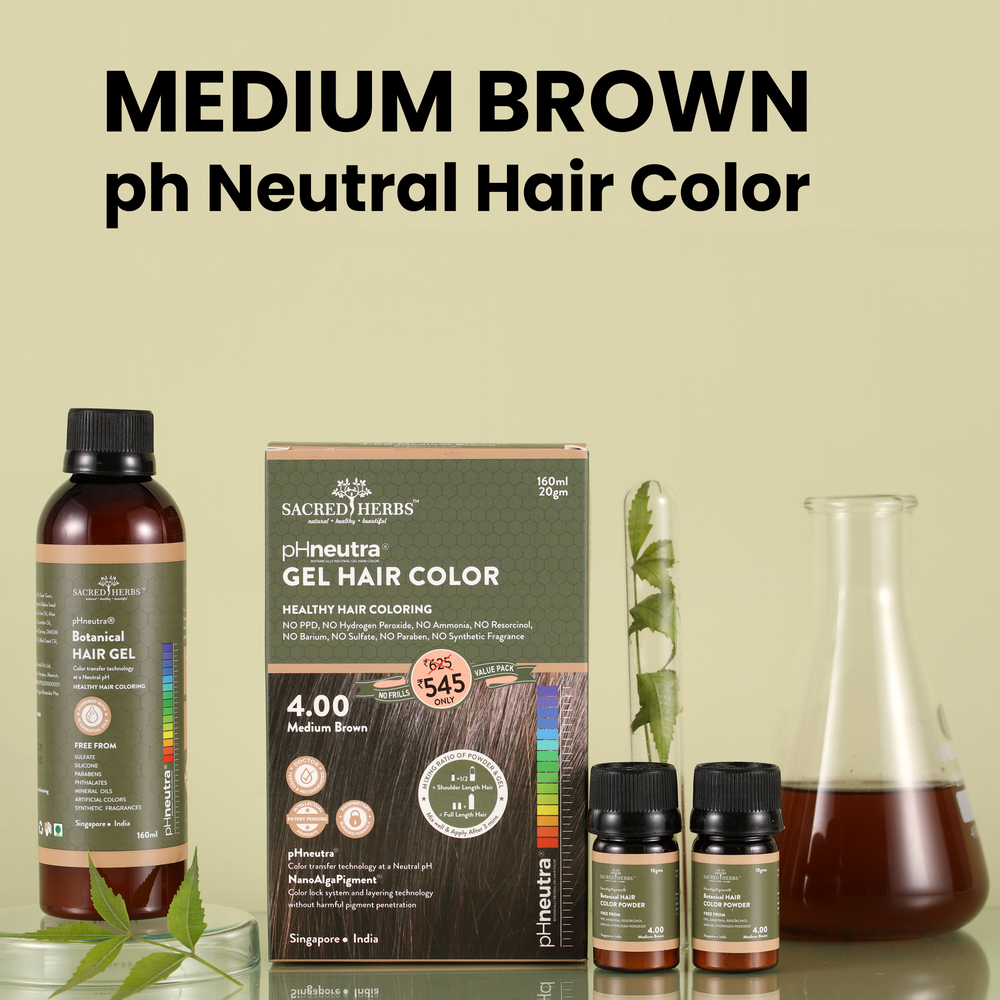
Medium Brown: warm chestnut. Works well for women transitioning from highlighted or lighter chemical colour.
Light Brown: soft, golden-warm. Best results on hair that is already medium brown or lighter. On very dark base hair, may not produce visible colour change on pigmented portions.
Burgundy: deep wine-red with purple undertones. The most fashion-forward option. Works well on dark hair without requiring bleach. Grey portions take on a deep burgundy tone; pigmented portions show a warm red overlay.
Decision Point 4: The Application Protocol for Complete Grey Coverage
This is the most critical section for anyone who has previously been disappointed with natural hair colour for grey hair. The protocol here differs from generic instructions in ways that specifically address resistant grey.
48 hours before: patch test
Apply a small amount of mixed colour to the inside of your ear. Leave for 20 minutes, rinse, and monitor for 48 hours. No reaction means you are clear to proceed.
Day before or morning of: hair preparation
Wash with a sulphate-free shampoo. No conditioner. Hair should be clean without any conditioning barrier between the colour and the cuticle. Towel-dry to damp.
Strand test (for first-time users):
Take a half-inch section from behind the ear. Apply colour, process for the full time, rinse, and dry. Evaluate the result before committing to a full application.
Mixing:
Mix components immediately before application. Stir thoroughly until completely uniform. Work quickly: the activation begins when components are combined.
Application: the resistant grey protocol
Section hair into four quadrants. Begin at the areas of highest grey concentration: temples, hairline, crown parting.
Apply with a tinting brush, pressing the formula firmly into each strand rather than surface-painting. Press, saturate, and coat each section completely before moving to the next.
Check the parting lines and the nape of the neck specifically. These are the most commonly missed areas.
Apply to mid-lengths and ends last, as these need less penetration time than roots.
Processing: the heat step that changes everything
Cover with a shower cap immediately after application.
Set a timer for 40 minutes.
At the 30-minute mark, take a hairdryer on the lowest heat setting and direct it over the shower cap for the remaining 10 minutes. Move slowly around the head, covering all areas equally.
The heat step reduces the viscosity of the gel formula and accelerates the diffusion of botanical pigment molecules into the cuticle. This is the single most effective technique for achieving complete coverage on resistant grey. It is not optional if your grey is resistant.
Rinsing:
Lukewarm water. Rinse until the water is completely clear. This takes longer than rinsing conventional dye. Be thorough.
Use sulphate- and paraben-free shampoo.
Apply a colour-protecting conditioner from mid-length to ends. Leave for three minutes. Rinse with cool water to close the cuticle.
48-hour rule:
Use paraben- and sulphate-free shampoo for 48 hours. No swimming. Minimise heat styling. The botanical pigments continue bonding to the hair's keratin during this window.
Decision Point 5: Caring for Grey Hair After Natural Colouring
Grey hair that has been naturally coloured has specific care needs that differ slightly from pigmented coloured hair.
Shampoo: Sulphate-free is essential. Grey hair that is coloured with natural colour fades faster with sulphate shampoos than with sulphate-free alternatives.
Washing frequency: Less is more. Every wash removes a small amount of pigment. Two to three times per week is optimal for colour longevity.
Water temperature: Cool to lukewarm. Hot water opens the cuticle and accelerates colour loss.
Deep conditioning: Grey hair that has been coloured benefits from weekly deep conditioning to restore moisture and maintain cuticle integrity between applications.
Sun protection: UV degrades botanical pigments. A UV-protective leave-in spray or wearing a hat in strong sun significantly extends colour life.
Between-application colour support: Some people use botanical colour-depositing conditioners between full applications to refresh the colour on grey portions without a full process.
Explore the Hair Care Collection at Sacred Herbs, including the ColorLock Series designed specifically to protect and extend botanical colour on grey hair.
Decision Point 6: When to Recolour
Most people find their grey roots become visible at three to four weeks, and the colour itself begins to fade at five to six weeks. Recolouring is typically needed every four weeks.
Unlike conventional dye, natural hair colour for grey hair has no minimum interval requirement. The hair's structure is not damaged by application, so you can recolour as soon as the grey regrowth becomes visible without any cumulative harm.
Frequently Asked Questions
Will natural hair colour cover stubborn white hair?
Yes. White hair, which is completely melanin-free, is actually more receptive to botanical pigment in some ways because there is no competing melanin. The key is the full processing time (35 minutes) and the heat step.
How many applications does it take to reach a consistent, even result?
The first application on previously chemically coloured hair may be slightly uneven due to variable porosity. By the second or third application, the hair's porosity evens out and the result becomes consistent and rich.
Can I use natural hair colour for grey hair on eyebrows?
Not without specific precautions. Eye area application requires a formula tested for periorbital use. Standard hair colour formulas, even natural ones, should not be applied near the eyes.
Does natural hair colour for grey hair work in a single step or does it require two steps?
Modern botanical gel colour formulas are single-step. Traditional henna and indigo require two separate applications. Well-formulated gel colour achieves brown to black shades in a single application.
What happens if I stop using natural hair colour for grey hair?
Because natural colour is deposited rather than oxidative, it fades gradually rather than producing a harsh grow-out line. Stopping is a gradual process visually, which is one of the advantages of botanical colour over conventional dye.