Herbal Hair Dye: A Deep Dive Into History, Science, and Modern Formulation
Herbal hair dye is older than the idea of 'hair dye' as a product category. Long before laboratories synthesised para-phenylenediamine in 1863, people across the world were colouring their hair using plants. The Egyptians used henna and indigo. The Romans used lead comb and walnut husks. Ancient Indians combined amla, bhringraj, and shikakai into hair treatments that coloured, conditioned, and strengthened simultaneously.
The modern herbal hair dye is both a return to that history and a leap forward in science. Today's best herbal dye formulas combine centuries-tested botanical colourants with nanotechnology, microbial pigments, and oil-based delivery systems that would be unrecognisable to the ancient practitioners who first discovered these plants' properties. The result is a product category that delivers real colour performance while keeping the scalp and hair in better health than conventional dye ever could.
This article is a thorough exploration of herbal hair dye: where it came from, how it works chemically, how it compares to conventional dye across every meaningful dimension, how to apply it for best results, and how to care for the colour after application.
A Brief History of Herbal Hair Colouring
The use of henna for hair colouring dates to at least 5000 BCE in ancient Egypt. Mummies have been found with hennaed hair and nails. In the Indian subcontinent, henna (called Mehendi) has been used for hair colouring, conditioning, and ritual decoration for at least 3000 years.
Indigo as a hair colourant was documented in Ayurvedic texts dating to around 1000 BCE. The combination of henna and indigo to produce natural black and dark brown shades was the primary hair colouring method in South Asia, the Middle East, and North Africa for millennia.
Other traditional herbal colourants include:
-
Walnut (Juglans regia): used across Europe and the Middle East for darkening hair; the active compound is juglone
-
Chamomile (Matricaria recutita): used to brighten and highlight blonde hair
-
Black tea and coffee: traditional darkening treatments for brunettes
-
Amla (Phyllanthus emblica): the Indian gooseberry, used for deep conditioning and to add cool dark tones
-
Bhringraj (Eclipta prostrata): Ayurvedic herb credited with promoting hair growth and darkening greying hair
The industrial era largely displaced these traditional colourants with the convenience and extended shade range of synthetic oxidative dyes. But the resurgence of interest in herbal hair dye today is not nostalgia. It is evidence-based preference, driven by growing awareness of synthetic dyes' risks and modern herbal formulations that have solved the traditional limitations.
The Chemistry of Herbal Hair Dye
Understanding how herbal hair dye works requires a basic understanding of hair structure. Each strand of hair has three layers: the cuticle (outermost), the cortex (middle), and the medulla (innermost). Hair colour, both natural and applied, lives primarily in the cortex. The cuticle's job is to protect the cortex.
How Conventional Dye Works
Conventional oxidative dye uses alkaline agents (typically ammonia) to raise the hair's pH from its natural 4.5 to 5.5 up to pH 9 or 10. At this elevated pH, the cuticle swells and lifts, opening access to the cortex. Hydrogen peroxide then oxidises the natural melanin, bleaching it. Simultaneously, small oxidative dye molecules (including PPD) enter the cortex and undergo polymerisation, forming large colour molecules that are trapped inside. The cuticle then (imperfectly) closes.
The problem is compounded with each application. Each time the cuticle is forced open by high pH, some cuticle structure is permanently lost. The hair becomes progressively more porous, more fragile, and more prone to breakage.
How Herbal Hair Dye Works
Herbal hair dye operates through a fundamentally different mechanism. The primary pathway is direct substantive colouring: botanical pigment molecules bond directly to the keratin proteins in the cuticle and cortex without requiring the cuticle to be opened.
Henna's colouring molecule, lawsone (2-hydroxy-1,4-naphthoquinone), has a natural affinity for keratin. It migrates into the hair shaft through the intercellular channels between cuticle scales, without requiring any chemical disruption of the cuticle structure. Once inside, it forms a stable bond with the hair's keratin proteins through a process called the Maillard reaction, creating genuinely durable colour.
Advanced herbal dye formulas use NanoAlgaPigment technology to further enhance this process. Nano-particle pigments derived from algae are small enough to penetrate between cuticle scales more efficiently than larger botanical pigment molecules, accelerating and deepening the colour result.
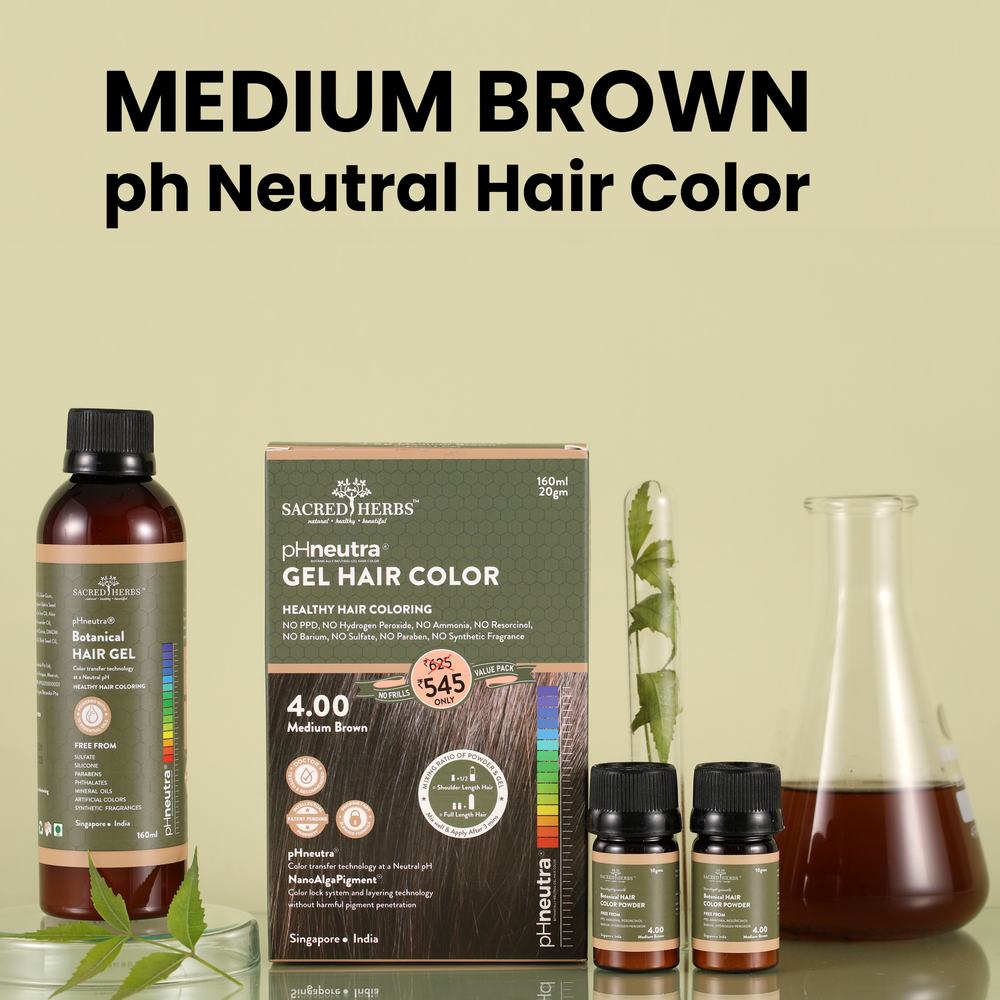
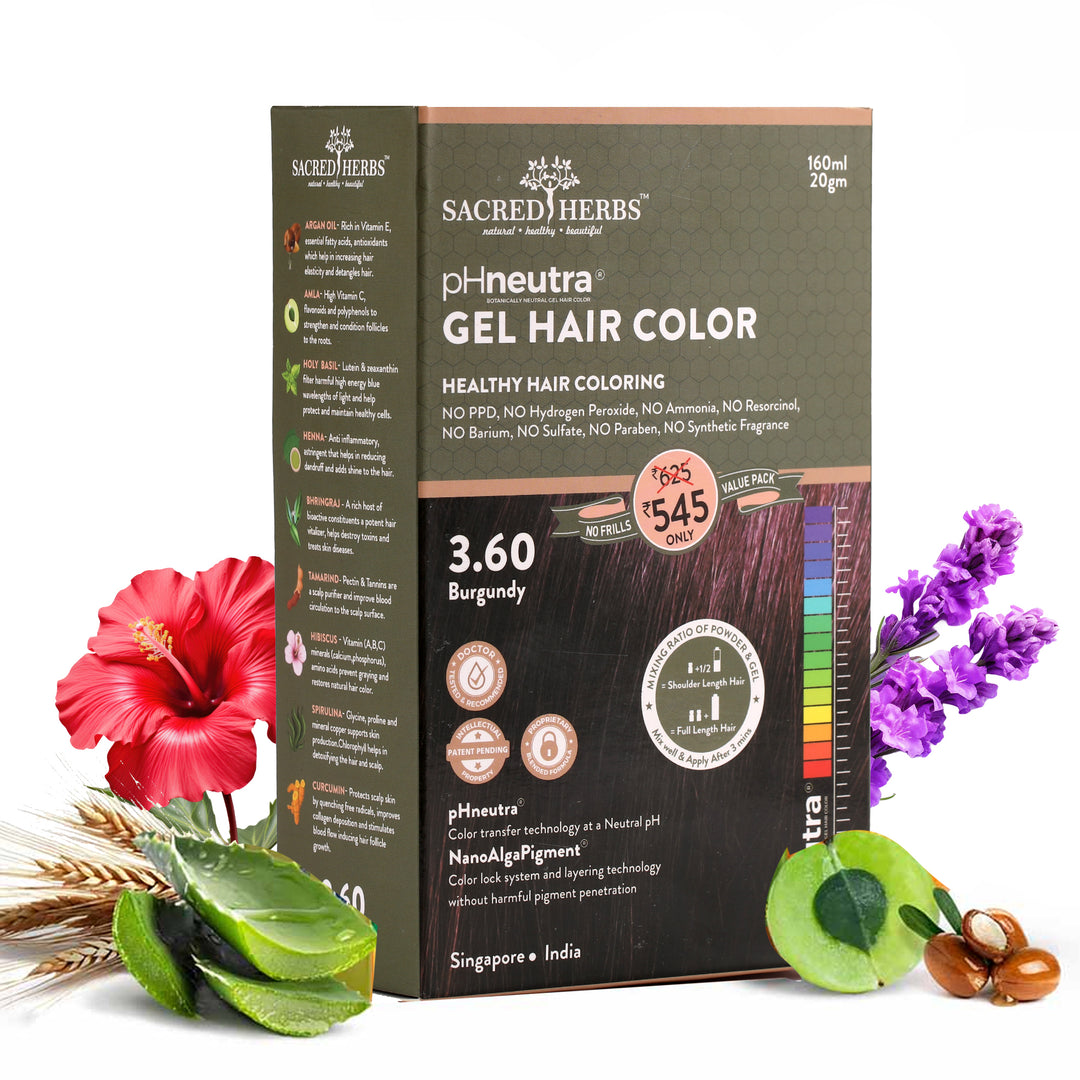
Sacred Herbs' pH Neutral Gel Technology (pHneutra) maintains a near-neutral pH throughout the colouring process. This means the cuticle is never forced open, the hair's protein structure is never disrupted, and the conditioning components in the formula work with the hair rather than against it. Explore the full Hair Colour Collection to see the range of shades available.
Herbal Hair Dye vs Conventional Hair Dye: A Detailed Comparison
Colour Longevity
Conventional dye: 6 to 8 weeks before regrowth becomes visible. The colour itself may remain for longer, though it fades gradually.
Herbal hair dye: 4 weeks for most formulas. Because herbal dye coats rather than penetrates the cortex as deeply, it fades somewhat faster. However, because it can be applied frequently without damage, touch-ups are not a concern.
Grey Coverage
Conventional dye: complete grey coverage is reliable and predictable with a standard 30-minute processing time.
Herbal hair dye: complete grey coverage is achievable but may require 40 to 50 minutes of processing time, gentle heat, and correct application technique. Modern formulas with NanoAlgaPigment significantly close this gap.
Shade Range
Conventional dye: virtually unlimited, including lightening (which requires bleach in a separate step) and the full colour wheel.
Herbal hair dye: the natural shade range covers black through light brown, burgundy, and auburn. Lightening is not possible without bleach. For the majority of hair colouring needs, which involve covering grey or going a shade or two darker, the herbal range is entirely adequate.
Hair Condition Post-Colouring
Conventional dye: hair is typically drier, more porous, and weaker after colouring. Intensive conditioning is required to restore manageability.
Herbal hair dye: hair is typically in equal or better condition after colouring. Henna and botanical actives coat and strengthen the cuticle. No intensive post-treatment is typically required.
Scalp Safety
Conventional dye: PPD, ammonia, and resorcinol are known contact allergens and irritants. Repeated exposure increases sensitisation risk.
Herbal hair dye: significantly safer profile. PPD-free and ammonia-free. Botanical colourants have a much lower sensitisation rate. Patch testing is still recommended, as sensitivities to plant extracts are possible.
How to Apply Herbal Hair Dye for Maximum Effectiveness
Before You Begin
Do a strand test 24 hours before full application to check colour results, and a patch test 48 hours before to check for any sensitivity reaction. Have your supplies ready: tinting brush, mixing bowl (if applicable), old towel, shower cap, gloves.
Hair Preparation
Apply to clean, damp hair. Washing the day before is ideal: the hair is clean but has had time to produce a small amount of natural oil, which aids in even colour distribution.
Application
Work in sections. Start at the hairline and the areas with the most grey (typically temples and crown). Apply generously using a brush, ensuring every strand is fully coated from root to end. Do not rush this step: even coverage is the difference between a rich, uniform result and a patchy one.
Processing
Cover with a shower cap. Process for 35 minutes. Adding gentle heat for the final 10 to 15 minutes significantly improves pigment absorption, particularly on resistant grey.
Rinsing
Rinse thoroughly with lukewarm water until water runs clear. The rinsing process for botanical dyes often takes longer than for conventional dye because the formula is thicker. Be thorough: residual product on the scalp can cause dryness.
Post-Application Hair Care
The 48 hours after application are critical for colour longevity. During this period, the botanical pigments are still settling and bonding fully to the hair's keratin. Avoid heat styling. Avoid swimming in chlorinated water.
After 48 hours, maintain colour with:
-
A sulphate-free colour-safe shampoo
-
A conditioning treatment that restores hydration without silicone build-up
-
A leave-in serum or hair oil to seal the cuticle and reduce colour-fading friction
The Sacred Herbs Hair Care Collection includes a ColorLock Series specifically formulated to protect and extend the life of botanical hair colour, with a colour-locking shampoo, conditioner, and leave-in treatment.
Frequently Asked Questions
Is herbal hair dye the same as henna?
Henna is one ingredient in herbal hair dye, but modern herbal hair dye is not the same as pure henna. Good herbal dye formulas combine henna with indigo, botanical actives, conditioning agents, and in advanced formulas, microbial pigments and nanotechnology. The result is more versatile, more precisely shaded, and easier to apply than traditional henna powder.
Can I use herbal hair dye on eyebrows or beard?
Herbal hair dye can be used on beard hair. For eyebrows, extreme caution is required: proximity to the eyes means any product irritation carries a higher risk. Use only products specifically formulated for facial hair in those areas.
Does herbal hair dye smell as strong as chemical dye?
No. The characteristic ammonia smell of conventional hair dye is absent in herbal formulas. Botanical dyes have a mild, earthy, or herbal aroma. Some people find this pleasant; others are neutral to it. It is significantly less pungent than ammonia-based dye.
Can I colour over herbal hair dye with conventional dye?
Yes, with caveats. Henna can sometimes interfere with conventional dye chemistry, producing unexpected results. If you are transitioning from herbal to conventional colour, do a strand test first and be aware that results may vary from the colour chart.
Is herbal hair dye vegan?
Most modern herbal hair dye formulas are vegan. Always check the ingredient list for any animal-derived components (such as certain proteins). Sacred Herbs products are formulated with a cruelty-free approach.
How do I know if a product is genuinely herbal or just marketed as herbal?
Read the ingredient list. A genuinely herbal dye should list botanical colourants (Lawsonia inermis for henna, Indigofera tinctoria for indigo) prominently and should not list paraphenylenediamine (PPD), ammonia, ammonium hydroxide, or resorcinol.