7 Reasons More Indians Are Choosing Herbal Hair Color Over Conventional Dye
India has one of the most sophisticated traditions of herbal hair care in the world. Amla, henna, methi dana, brahmi, bhringraj, shikakai, and indigo have been used for hair colouring, strengthening, and scalp care for thousands of years. Yet for most of the 20th century, the arrival of Western chemical dyes pushed these traditions to the margins.
That is changing. Herbal hair colour is no longer just the option for those who prefer traditional methods. It is increasingly the choice of well-informed consumers who understand what chemical dyes do and want something better. Here are seven specific reasons the shift is happening.
1. The Scalp Absorption Problem with Chemical Dyes Is Real
The scalp is one of the most permeable surfaces on the body. It absorbs topical substances significantly more readily than the skin on your arm or leg. This is why scalp-applied treatments like minoxidil work so effectively, but it is also why the chemicals in conventional hair dye raise genuine safety concerns.
PPD (para-phenylenediamine), the primary colouring agent in most conventional dyes, is classified as a contact allergen by the European Union and has been the subject of ongoing research into its potential links to bladder cancer in frequent, long-term users. Ammonia irritates the respiratory system and the mucous membranes. Resorcinol disrupts the thyroid hormone system in animal studies.
Herbal hair colour eliminates these specific risks. Botanical colourants like henna's lawsone and indigo's indigotine do not carry the same toxicological profile. They are biodegradable and have a centuries-long safety track record. For someone who colours their hair every four to six weeks, the cumulative difference in chemical exposure is significant.
2. It Does Not Compromise Grey Coverage
The most persistent misconception about herbal hair colour is that it cannot properly cover grey. This was partially true of traditional powder henna applied in the old two-step method, which required henna first, then indigo, and still produced inconsistent results.
Modern herbal hair colour formulations have solved this. Using NanoAlgaPigment technology, algae-derived microbial pigments, and optimised botanical colourant ratios, today's herbal hair colour products deliver complete grey coverage in a single step. The colour result is comparable to conventional dye in terms of uniformity and depth. In many cases, grey hair actually responds better to herbal colourants because the absence of natural melanin in grey hair leaves more 'space' for botanical pigment to bond.
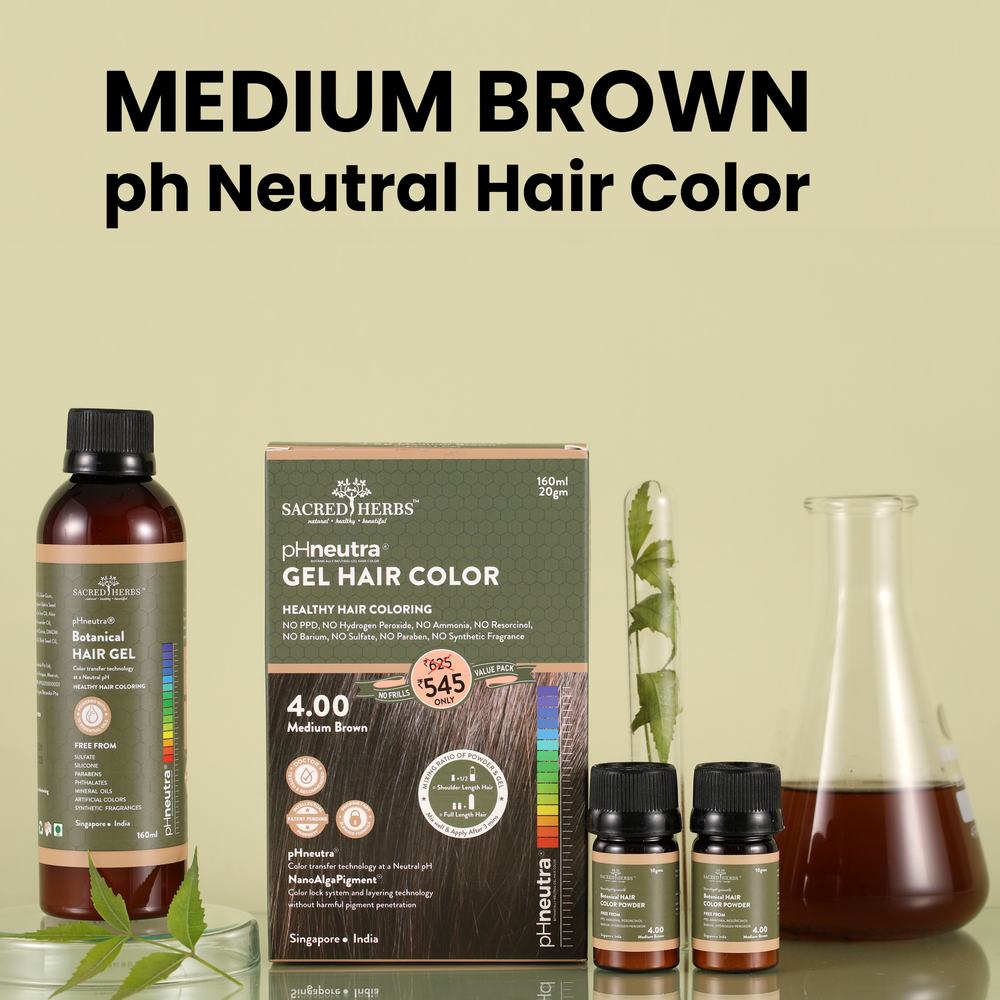
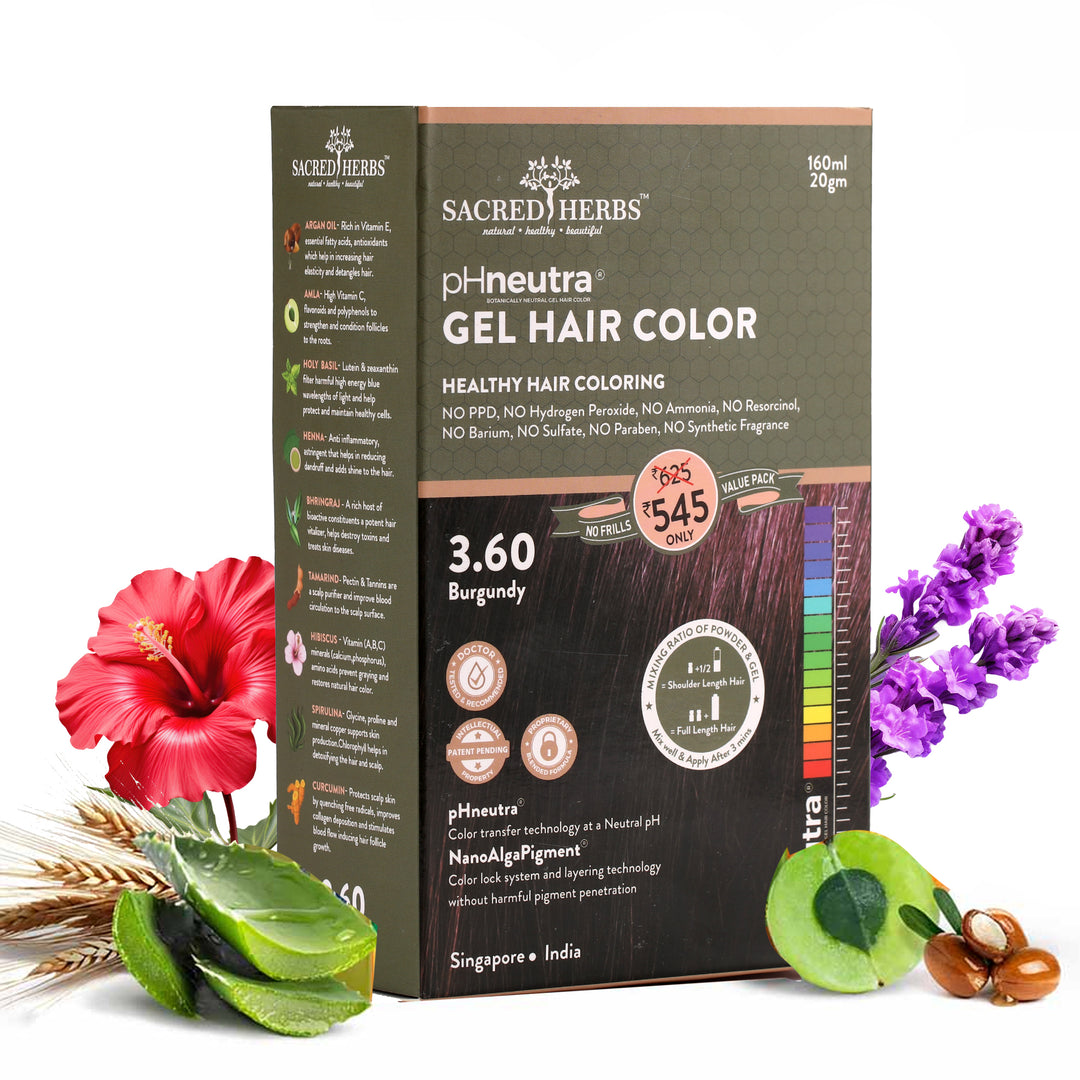
Sacred Herbs' pH Neutral Gel Hair Colour range covers grey hair fully across all five shades, from Natural Black to Burgundy.
3. The Hair Is Stronger After Colouring, Not Weaker
This is perhaps the most striking difference between herbal hair colour and its chemical counterpart. With conventional dye, each application opens the cuticle slightly more than it was before. Over time, this results in progressively drier, more porous, and more breakage-prone hair.
With herbal hair colour, the opposite is true. Henna, which forms the colouring base in most herbal formulas, coats the hair shaft with a layer of lawsone molecules that bond to the keratin. This adds strength, reduces porosity, and decreases breakage. Hair that is coloured regularly with herbal dye tends to become thicker and more resilient over time, not thinner.
Botanical actives in the formula (amino acids, flavonoids, polyphenols, phytonutrients) further support the hair's protein structure during the colouring process. The result is hair that looks and feels better with each application.
4. It Is the Safest Option for People with Scalp Conditions
Psoriasis, seborrheic dermatitis, contact dermatitis, and general scalp sensitivity are extremely common, particularly in high-pollution urban environments. For anyone with these conditions, conventional hair dye can be genuinely dangerous. The high-pH alkaline environment created by ammonia, combined with the sensitising properties of PPD, can trigger severe flares.
Herbal hair colour at a neutral pH does not disrupt the scalp's acid mantle. It does not trigger the inflammatory cascade that ammonia-based dyes provoke. And the absence of PPD removes the most common cause of allergic contact dermatitis from hair dye.
5. It Fits Into a Clean Beauty Routine
The clean beauty movement in India is growing rapidly, particularly among urban consumers aged 25 to 45. This group is increasingly scrutinising ingredient labels, avoiding products with parabens, sulphates, and synthetic fragrance, and choosing brands that align with their values around health, sustainability, and environmental responsibility.
Herbal hair colour aligns naturally with these values. Botanical colourants are renewable and biodegradable. The production process for plant-derived pigments has a significantly lower environmental footprint than the industrial chemistry required to produce synthetic dye molecules. And the skin-safety profile of herbal colourants is dramatically better than synthetic alternatives.
Sacred Herbs extends this philosophy beyond hair colour to a complete clean beauty range. The Body Care Collection uses herbal botanicals in body cleansers and bath products formulated with the same commitment to natural, active-led ingredients.
6. It Is Better for Frequent Colouring
Grey coverage typically requires re-application every four weeks. For someone who has been greying since their 30s and colours regularly, that could be eight to twelve colour applications per year, every year, for decades.
The cumulative structural damage of eight to twelve annual ammonia-based colour applications over a decade is not trivial. Hair becomes progressively more porous, drier, and more prone to breakage. Many women who have coloured with conventional dye for years find that they need more and more conditioning treatments just to maintain manageability.
Herbal hair colour can be applied as frequently as needed without this cumulative damage. In fact, because each application adds a layer of botanical coating to the hair shaft, frequent use of herbal colour tends to improve hair condition rather than degrade it.
7. The Colour Results Are Genuinely Beautiful
This point deserves to be made clearly, because it is the one that matters most to anyone choosing a hair colour product. A hair colour is only as good as the colour it delivers.
Modern herbal hair colour delivers rich, multi-dimensional colour that is comparable in beauty to anything chemical dye can achieve within the brown-to-black range. The natural pigments in henna and indigo interact with light differently from synthetic dyes, producing a colour that shifts subtly in different lighting, has warmth and depth, and generally looks more 'alive' than the flat uniformity of many synthetic hair colours.
Burgundy shades have a wine-like richness. Dark brown has genuine warmth. Medium brown catches the light with natural-looking variation. These are not 'good for a natural dye' results. They are simply good results.
Frequently Asked Questions
Is herbal hair colour permanent or semi-permanent?
It depends on the formula. Henna-based colour bonds to keratin and is technically permanent, though it fades gradually over four weeks. Modern herbal hair colour gel formulas occupy a middle ground: more lasting than rinse-off semi-permanent colour but slightly less permanent than oxidative dye.
Can I mix herbal hair colour with conventional dye?
It is not recommended. Henna and indigo can interact unpredictably with the peroxide used in conventional dyes. Always do a strand test if transitioning from chemical to herbal colour.
Does herbal hair colour work the same on all hair types?
Yes, but processing time may vary. Coarser, thicker hair may need a longer processing time. Fine hair tends to absorb pigment quickly. Colour results will also vary depending on your natural hair colour: the same shade will look darker on lighter hair and lighter on very dark hair.
Can herbal hair colour be used on chemically straightened or permed hair?
Yes. Herbal hair colour is generally compatible with chemically processed hair. However, processed hair tends to be more porous, which means it absorbs pigment faster and may fade sooner. Use a colour-protective shampoo and conditioner to extend longevity.
What is the difference between herbal hair colour and box dye?
Box dye almost always contains ammonia, PPD, and hydrogen peroxide. Herbal hair colour replaces these with botanical colourants and low-irritation carrier systems. The difference is both in the colouring chemistry and in the post-application condition of the hair.