Chemical-Free Hair Dye: A Science-Forward Guide for the Informed Consumer
Most articles about chemical-free hair dye are written for people who are already convinced they want it and just need to know which one to buy. This article is written for a different reader: someone who wants to understand the actual science before making a decision. It answers the hard questions directly, acknowledges what chemical-free hair dye does not do as well as what it does, and gives you the tools to make an informed choice rather than a faith-based one.
What "Chemical Free" Actually Means (And What It Does Not)
Let's be precise from the start. Nothing is chemical-free. Every substance in the universe is made of chemicals. Water is a chemical. Air is a mixture of chemicals. This is basic chemistry.
What people mean when they say chemical-free hair dye is: hair dye free from the specific synthetic chemicals that carry established toxicological risks in the context of hair colouring. The relevant chemicals are:
Para-phenylenediamine (PPD): The primary colouring agent in most permanent and semi-permanent oxidative hair dyes. A documented contact allergen and strong sensitiser. The most common cause of serious allergic reactions to hair dye. Associated in epidemiological studies with elevated risk of bladder cancer and non-Hodgkin's lymphoma in frequent, long-term users.
Ammonia (and monoethanolamine): Used to raise hair pH and open the cuticle. Irritates respiratory mucous membranes during application. Destroys the scalp's acid mantle. Creates an inflammatory environment at the follicle with each application.
Resorcinol: A colour coupler that allows certain shades (particularly darker ones) to be achieved. Classified as an endocrine disruptor. Has demonstrated thyroid hormone interference in animal studies.
Parabens: Preservatives with weak oestrogenic activity. Detected in breast tumour tissue in research studies. Not confirmed as causative, but increasingly excluded from cosmetic formulas as a precaution.
Hydrogen peroxide: The oxidising agent in conventional dye that bleaches natural melanin. At concentrations used in standard dye, it generates free radicals that damage the hair's protein structure and follicle cells.
Chemical-free hair dye replaces these specific compounds with botanical alternatives that achieve colour through different mechanisms without these toxicological risks. The replacement is the entire point.
Section 1: The Biology of Why Chemical Hair Dye Is Harmful
Conventional Hair Dye: How It Works and What Consumers Should Know" of "How Conventional Hair Dye Works, and Why Some Ingredients Can Cause Concern
The scalp permeability problem:
The scalp is not like other skin. Its permeability, the rate at which it absorbs topical substances, is higher than almost any other body surface. Studies comparing scalp absorption to forearm absorption typically show the scalp absorbs substances four to six times more readily.
This means that when you apply hair dye to your scalp, you are not just coating a surface. You are introducing chemicals into your body. PPD, resorcinol, and other dye components measurably enter systemic circulation following scalp application. This is why hairdressers, with the highest occupational exposure, show elevated rates of certain cancers in epidemiological studies.
The systemic absorption argument is what most anti-chemical-dye advocacy focuses on. But there is also a significant local argument.
The local inflammation cycle:
Ammonia raises the hair's pH from its natural 4.5-5.5 to 9-10 during application. This alkaline environment destroys the scalp's acid mantle, the protective slightly acidic layer that prevents pathogen colonisation, regulates sebum production, and maintains barrier integrity.
After rinsing, the acid mantle takes 24-72 hours to recover. But with recolouring every four to six weeks, the acid mantle is under continuous chemical assault. The chronic disruption creates a persistent low-grade inflammatory state that, over months and years, contributes to scalp sensitivity, increased reactivity to other products, and in some people, accelerated follicle ageing and hair fall.
The structural damage accumulation:
Each conventional dye application opens the cuticle by chemical force, allows oxidative chemistry to modify the cortex, and then closes the cuticle imperfectly. After the first application, the cuticle is slightly more damaged than before. After the tenth application, it is meaningfully more porous, more fragile, and less able to retain moisture. After years of regular colouring, once resilient hair becomes brittle, prone to breakage, and heavily dependent on conditioning treatments just to maintain manageability.
Chemical-free hair dye avoids all three of these harm pathways simultaneously.
Section 2: The Chemistry of Chemical-Free Hair Dye - How It Works
If chemical hair dye uses oxidative chemistry to disrupt the hair and deposit synthetic pigments, chemical-free hair dye uses substantive colouring: botanical pigments that bond to the hair's protein structure through natural chemical affinity.
The lawsone-keratin bond:
Henna (Lawsonia inermis) produces a molecule called lawsone (2-hydroxy-1,4-naphthoquinone). Lawsone has a remarkable property: it has a natural and highly specific affinity for keratin, the protein that makes up human hair.
Lawsone migrates from the applied formula into the hair shaft through the intercellular lipid pathways between cuticle scales. These pathways exist naturally in the hair and are permeable to small, lipid-compatible molecules. Lawsone does not need the cuticle to be forced open; it travels through existing channels.
Once inside the cortex and cortical cells, lawsone forms a covalent bond with the free amine groups on keratin protein chains. This is a stable, permanent chemical bond. The colour does not wash out because the lawsone molecule is now chemically bound to the hair's protein structure. It only disappears as the coloured hair grows out and is cut.
This bond also has a structural benefit: the lawsone-keratin bonds add cross-links to the keratin structure that increase the hair shaft's tensile strength and reduce its porosity.
Indigo's mechanism:
Indigofera tinctoria produces indigotin, which deposits deep blue-black colour through a different mechanism from lawsone. Indigotin is a larger molecule that is absorbed into the cuticle structure and intercellular matrix rather than bonding covalently to keratin. It creates the dark tones that, combined with henna's warm red-brown, produce the full range of brown to black shades in chemical-free hair dye.
NanoAlgaPigment enhancement:
Modern chemical-free hair dye has significantly improved on traditional botanical colouring through the incorporation of algae-derived microbial pigments at nano-particle scale. These nano-pigments are:
Small enough to penetrate more deeply and rapidly than larger botanical molecules, producing more even colour saturation.
Stable enough to resist fading from washing and UV exposure at rates comparable to conventional dye.
Derived from renewable biological sources with a significantly lower environmental footprint than synthetic dye chemistry.
The combination of traditional botanical colourants and NanoAlgaPigment technology closes the performance gap between chemical-free and conventional hair dye to a degree that was not achievable with botanicals alone.
Section 3: What Chemical Free Hair Dye Does Better, What It Does Comparably, and Where It Still Lags
This section is the honest accounting that most chemical-free hair dye articles avoid.
Where chemical-free hair dye is clearly superior:
Scalp safety during and after application: no burning, no sting, no acid mantle destruction, no PPD sensitisation risk. The difference in comfort during application is immediately and consistently noticeable.
Hair condition post-application. Hair is stronger, not weaker. The cumulative effect of regular botanical colour is improved cuticle integrity. This is the opposite of conventional dye.
Long-term systemic safety. The absence of PPD, resorcinol, and ammonia from the formula eliminates the specific toxicological risks associated with these compounds.
Environmental impact. Botanical pigments are biodegradable. Synthetic dye molecules, particularly aromatic amines, are resistant to biodegradation and have documented aquatic toxicity.
Where chemical-free hair dye is comparable:
Grey coverage, when the formula includes NanoAlgaPigment and is applied with the correct technique (35-minute processing, heat step, full saturation).
Colour richness and depth in the dark shade range (natural black, dark brown, medium brown).
Longevity (4 weeks) relative to the maintenance interval required by most grey coverage consumers.
Where chemical-free hair dye still lags:
Processing time: 35 minutes versus 25-35 minutes for conventional dye.
Shade range: the natural shade range covers black through light brown plus burgundy. The full colour wheel, including vivid fashion colours and significant lightening, is not achievable with botanical colouring alone.
Consistency for very light shades on dark hair: botanical colour cannot produce blonde, platinum, or pastel results on dark hair without a preceding bleach process.
Section 4: The Application Protocol That Makes Chemical-Free Hair Dye Work
Chemical-free hair dye rewards correct technique more than conventional dye does. The following protocol produces complete, even grey coverage with maximum colour depth.
Preparation: Wash with sulphate-free shampoo 24 hours before. No conditioner. If in a hard water area, use a chelating shampoo wash to remove mineral deposits that can block pigment absorption.
Mixing: Combine components immediately before use. Mix thoroughly until completely uniform. Work quickly after mixing.
Sectioning: Four quadrants. Start at highest grey concentration: temples and crown.
Application: Use a tinting brush. Press the formula into the hair; do not surface-paint. Full saturation of every strand is the goal. Check parting lines and hairline carefully.
Processing: Shower cap on immediately. Thirty-five minutes minimum. Use hairdryer on lowest heat setting over the cap for the final ten minutes. This heat step is the technique that makes chemical-free hair dye fully competitive with conventional dye on grey coverage.
Rinsing: Lukewarm water until completely clear. No shampoo. Colour-protecting conditioner from mid-lengths to ends. Cool water rinse to close the cuticle.
48-hour window: Use sulphate- and paraben-free shampoo. Botanical pigments continue bonding during this period.
Section 5: Building a Chemical-Free Hair Care Routine
Chemical-free hair dye is most effective as part of a complete chemical-free hair care routine. The dye handles colour; the supporting products handle colour longevity, hair health, and scalp maintenance.
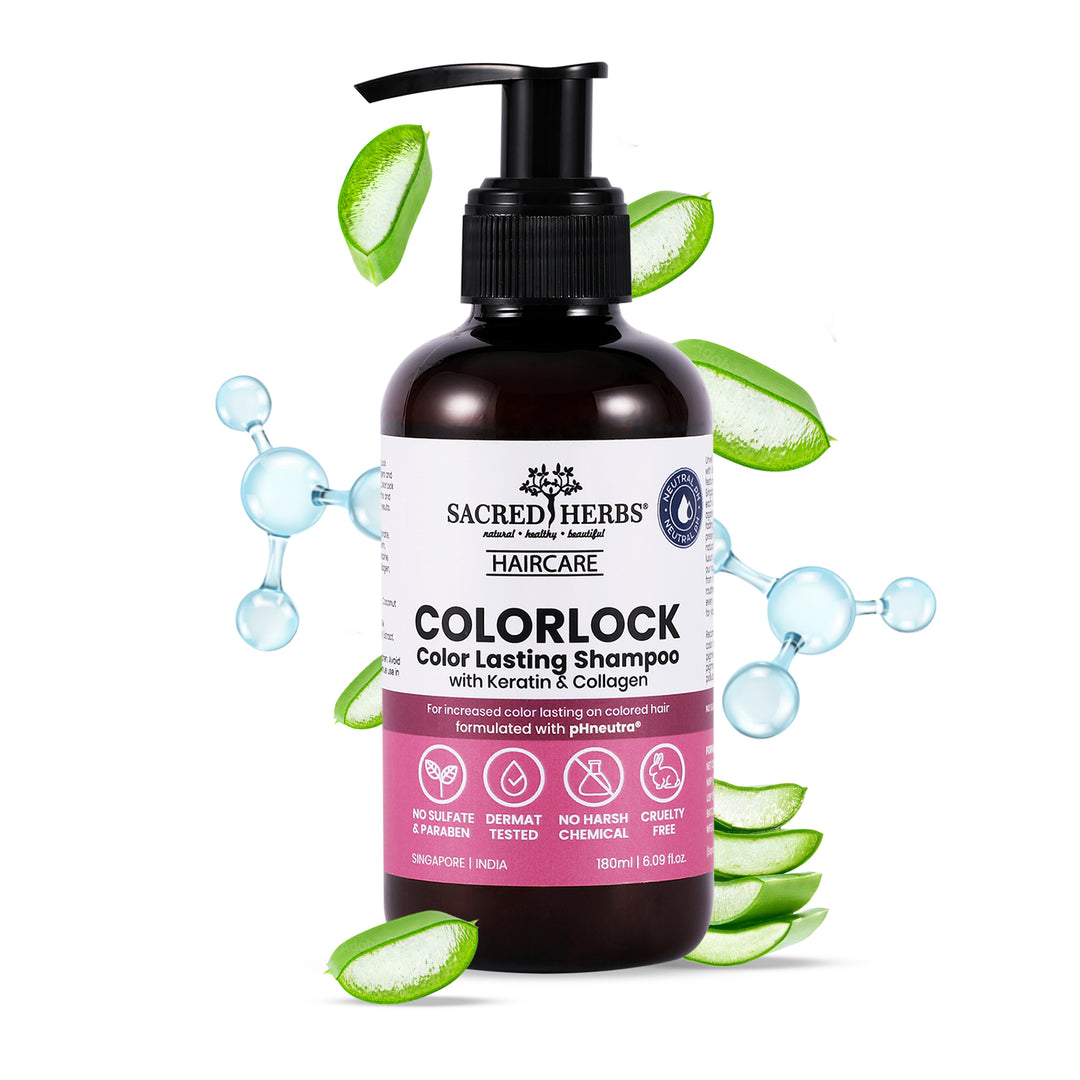
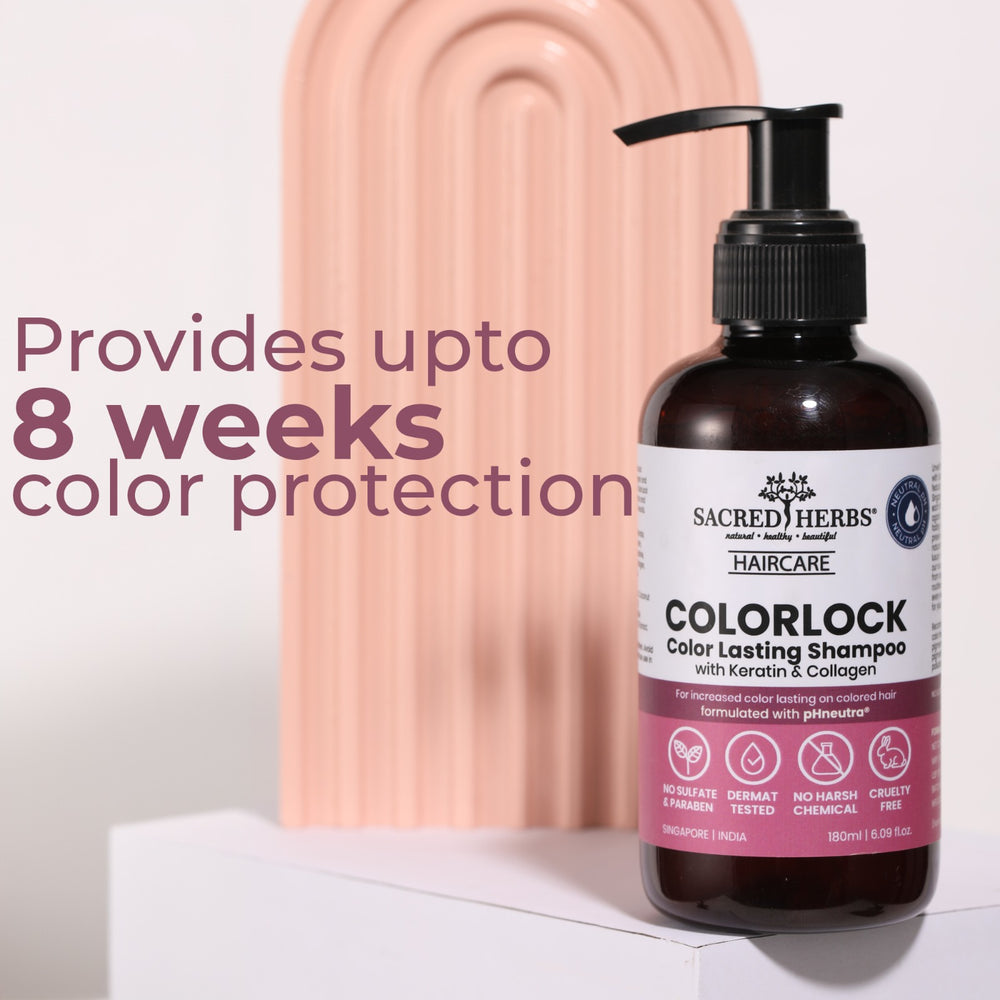
Shampoo: Sulphate-free, paraben-free, with botanical actives. SLS-containing shampoos strip colour significantly faster than botanical alternatives. Explore the complete Hair Care Collection at Sacred Herbs, which includes the ColorLock Series designed to extend botanical colour longevity.
Conditioner: Silicone-free, with hydrolysed proteins (keratin, silk) and humectants. Avoids build-up that blocks subsequent colour absorption.
Pre-wash oil treatment: Weekly herbal scalp oil application nourishes the follicle, loosens product build-up, and keeps the scalp environment healthy between colour applications.
Leave-in serum: A botanical leave-in serum (particularly rosemary-based) maintains scalp health and hair strength between washes and between colour applications.
Frequently Asked Questions
Can chemical-free hair dye be used by people with latex allergy?
Henna-based chemical-free hair dye does not contain latex proteins. However, the full ingredient list should always be reviewed for potential cross-reactive allergens. Patch testing remains essential regardless of allergy history.
Does chemical-free hair dye work on Afro-textured or very curly Indian hair?
Yes. The colouring mechanism works on all hair types. Curly and Afro-textured hair typically has high porosity, which means it absorbs botanical pigments readily. Section carefully and ensure thorough saturation through dense curl clusters.
Will chemical-free hair dye cause build-up over multiple applications?
No chemical-based build-up. Henna creates a botanical coating on the hair shaft that accumulates over multiple applications, which is generally beneficial (adds body and strength). Excessive henna build-up from many years of frequent use can create heaviness in some very fine hair types, addressed by taking a break of one or two applications.
Is chemical-free hair dye safe immediately after a keratin or smoothing treatment?
Wait at least two weeks after a keratin treatment before applying any hair colour, including chemical-free. The keratin treatment uses cross-linking chemistry that needs to stabilise before colouring. Conversely, apply any keratin treatments at least three weeks after botanical colour.
Can I use chemical-free hair dye if I have alopecia areata?
Consult a dermatologist first. Alopecia areata involves an autoimmune inflammatory process affecting the follicle. Chemical-free hair dye at neutral pH is significantly less likely to aggravate this than conventional dye, but the scalp in an active alopecia areata episode is particularly sensitive, and any topical application should be discussed with a specialist.